Many parents know the frustration of watching their child struggle with math. The numbers on the page seem confusing, and simple problems turn into moments of frustration. The excitement of learning fades, replaced by hesitation and self-doubt.
Some children lose confidence early, believing they are “bad at math” before they’ve had a real chance to understand it. Traditional methods often focus on memorisation rather than comprehension, leaving children disconnected from the logic behind numbers. The fear of making mistakes takes over, and soon, math becomes a source of stress instead of discovery.
Math toys change this experience by turning numbers into something a child can see, touch, and play with. Instead of staring at symbols on a worksheet, they explore patterns, solve puzzles, and build confidence through hands-on interaction. The right tools shift math from something intimidating to something exciting, helping children understand concepts naturally, often without even realising they’re learning.
Table of Contents
Math Toys And STEM Learning
STEM stands for science, technology, engineering, and mathematics. These subjects shape the modern world, influencing everything from medicine to transportation. STEM education encourages logical reasoning, hands-on problem-solving, and curiosity about how things work.
Rather than being separate subjects, STEM fields are deeply connected. Engineering relies on mathematics, science is driven by technology, and problem-solving ties them all together. The ability to analyse, test ideas, and find solutions forms the foundation of innovation.
Why STEM Is Important In Early Childhood
Early exposure to STEM builds confidence in problem-solving and logical thinking. Young children are naturally curious, constantly testing ideas and observing cause-and-effect relationships. Encouraging this curiosity lays the groundwork for stronger reasoning skills as they grow.
Studies show that children who engage with STEM concepts early are more likely to approach challenges with confidence. They learn to recognise patterns, compare quantities, and explore spatial relationships before encountering these ideas in a formal classroom setting. These skills help them navigate math and science lessons with greater ease and reduce frustration as concepts become more complex.
STEM learning in early childhood does not mean advanced calculations or technical lessons. It starts with exploration, hands-on discovery, and interactive play. The experiences children have with numbers, measurements, and problem-solving at a young age influence their ability to think critically and adapt to new challenges later in life.
Long-Term Impact Of STEM Education
Many of today’s fastest-growing careers require STEM skills. Engineers design sustainable buildings, programmers develop new technology, and scientists create medical advancements. Even careers outside traditional STEM fields benefit from the ability to think critically, analyse data, and solve problems logically.
Strong STEM skills prepare individuals for industries that rely on research, design, and technology. As automation and artificial intelligence reshape the workforce, the demand for professionals with a solid understanding of math and science continues to grow.
Benefits Of Math Toys In Early Education
Learning happens naturally when children play. The way they stack blocks, sort shapes, and recognise patterns lays the foundation for mathematical thinking long before they solve their first equation. When math is introduced through hands-on exploration, it becomes less intimidating and more intuitive.
Develop Problem-Solving And Logical Thinking
Problem-solving is one of the most important skills a child can develop. It allows them to approach challenges with confidence, break down problems into manageable steps, and find solutions through logical reasoning. Math toys introduce these skills naturally by presenting obstacles that require thinking, testing, and adjusting.
For example, a simple number puzzle may seem like just a game, but it teaches sequencing, attention to detail, and perseverance. Board games with mathematical elements help children weigh different choices, anticipate outcomes, and develop strategies. These experiences strengthen their ability to think critically, a skill that extends far beyond math and into everyday decision-making.
Make Abstract Concepts Tangible And Easier To Grasp
Numbers on a page can feel disconnected from real-world experiences. Math toys help bridge this gap by turning abstract ideas into something children can see and touch. Physical interaction with numbers, shapes, and patterns makes learning more intuitive and reduces the frustration that comes with struggling to grasp new concepts.
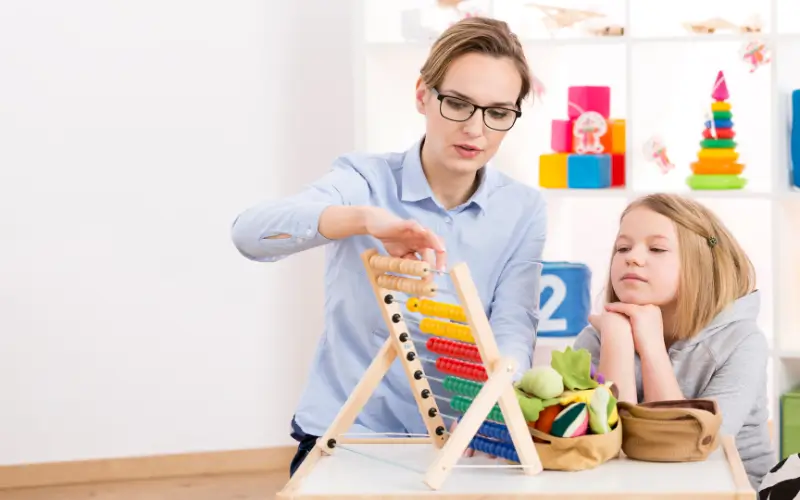
An abacus, for example, shows how numbers increase in value as they move across place value columns. Fraction tiles allow children to compare different fractional parts visually, reinforcing the idea of how numbers relate to each other. These hands-on tools create stronger connections between concepts and application, making it easier for children to retain what they learn.
Encourage A Positive Relationship With Math
Many children begin to doubt their ability to succeed in math at an early age. Struggles with worksheets and memorisation can make them feel discouraged, leading to frustration and avoidance. Math toys change this experience by introducing numbers in a relaxed, engaging way that builds confidence.
When children complete a challenging puzzle or solve a math-based game, they experience a sense of achievement. These small wins create a foundation of confidence, showing them that math is something they can master. By associating numbers with success and enjoyment, they are more likely to approach future math lessons with curiosity rather than fear.
Strengthen Early Cognitive Development
Math toys engage multiple areas of cognitive development, supporting memory, concentration, and reasoning skills. Children practice recall when they match numbers in a game, develop spatial awareness when they fit geometric shapes together, and improve focus when they track patterns and sequences.
Early exposure to math through play also strengthens neural connections related to logical thinking and problem-solving. This type of active engagement helps prepare children for more advanced learning, making future math challenges easier to tackle.
Types Of Math Toys And Their Uses

Math toys introduce concepts in a way that children can interact with, making learning feel like a natural part of play. Each type of math toy focuses on different skills, helping children develop numerical understanding, spatial awareness, and problem-solving abilities at their own pace.
Build Number Sense With Counting And Recognition
A strong foundation in math begins with understanding numbers. Before children can solve equations, they need to recognise numbers, compare quantities, and understand how counting represents real-world amounts.
Toys that allow children to physically manipulate objects while counting help reinforce these early concepts. They provide a visual and tactile way to grasp number relationships, which is especially helpful for young learners who are still developing abstract thinking skills.
Examples:
- Abacus helps children see numbers in groups, making addition and subtraction easier to understand.
- Counting bears and cubes teach one-to-one correspondence by helping children match objects to numbers.
- Number puzzles reinforce number recognition and sequencing in a hands-on way.
Develop Spatial Awareness Through Shapes And Patterns
Recognising shapes and understanding how they fit together builds the foundation for geometry, problem-solving, and logical thinking. Toys that encourage children to manipulate, rotate, and combine shapes strengthen these abilities while also improving hand-eye coordination.
Spatial reasoning skills help children with everything from reading maps to understanding how objects fit together in construction, design, and engineering.
Examples:
- Tangrams encourage children to form new shapes by rearranging pieces, improving spatial manipulation skills.
- Pattern blocks introduce symmetry, tessellation, and sequencing, which are important for both math and art.
- Building blocks allow children to experiment with balance, proportion, and structural stability.
Understand Size, Weight, And Measurement
Measurement plays a role in daily life, from following a recipe to understanding how far a distance is. Learning how to compare sizes, estimate quantities, and measure objects helps children develop an intuitive understanding of units and proportions.
Toys that introduce measurement concepts in a playful way help children grasp ideas like weight, volume, and length before they encounter these topics in formal math lessons.
Examples:
- Balance scales teach weight comparison and introduce the basics of physics.
- Measuring cups help children understand volume and fractions through hands-on experimentation.
- Rulers and tape measures provide an introduction to length and spatial estimation.
Practice Basic Operations And Problem-Solving
Once children develop number sense, they need tools to practice addition, subtraction, multiplication, and division in a way that feels engaging. Rote memorisation often leads to frustration, but interactive learning makes these concepts more approachable.
Games and visual tools help children recognise patterns in math operations, develop fluency, and apply problem-solving skills in real-time.
Examples:
- Math board games reinforce addition and subtraction through interactive play.
- Fraction tiles provide a visual way to compare and combine fractions.
- Multiplication flashcards strengthen recall and fluency in basic math facts.
Encourage Logical Thinking With Strategy-Based Play
Logical reasoning is a skill that extends beyond math into science, coding, and everyday decision-making. Toys that challenge children to think ahead, recognise patterns, and apply strategies help develop this ability.
Games that require counting moves, predicting outcomes, or sequencing steps train children to approach problems systematically.
Examples:
- Dice and probability games introduce concepts of chance and statistics.
- Strategy-based board games improve planning and decision-making skills.
- Coding toys and puzzles encourage step-by-step problem-solving and algorithmic thinking.
Math Toys For Different Age Groups
Children develop math skills in stages, beginning with number recognition and progressing to more advanced problem-solving. Each stage of learning builds on the previous one, shaping a child’s confidence in math. When children engage with interactive math toys throughout their development, they are more likely to approach math with curiosity and see it as a tool for understanding the world around them.
Toddlers And Preschool (Ages 2 To 5)
At this stage, children are just beginning to recognise numbers, shapes, and patterns. They learn best through play that stimulates their senses and encourages hands-on interaction. Bright colours, large pieces, and simple designs make math concepts easier to grasp.
Counting And Numbers
Toys that involve stacking, sorting, and matching help toddlers understand numbers in a concrete way. Large counting blocks and number puzzles allow them to practice recognising numerical symbols while improving fine motor skills.
Shapes And Patterns
Shape sorters and stacking toys help children identify geometric forms and develop an early understanding of spatial relationships. Sorting games introduce pattern recognition, which is an important foundation for logical thinking.
Early Primary (Ages 6 To 8)
As children begin school, their understanding of numbers expands. They start learning basic arithmetic, measurement, and geometry. Math toys should support these new skills through engaging activities that reinforce number relationships.
Arithmetic Skills
An abacus is a useful tool for practicing addition and subtraction in a hands-on way. By physically moving beads, children can visualise number operations instead of relying on memorisation. Dice-based games also encourage quick mental calculations while making learning more interactive.
Spatial Awareness
Pattern blocks and tangrams introduce symmetry, sequencing, and shape manipulation. These skills are essential for understanding geometry and problem-solving. Hands-on play with these materials strengthens a child’s ability to recognise patterns and think critically.
Upper Primary (Ages 9 To 12)
At this stage, children begin working with fractions, decimals, and multi-step problem-solving. Toys that provide a visual and interactive way to engage with these concepts make math more approachable.
Fractions And Decimals
Fraction circles and tiles help children see how parts form a whole. These tools allow them to compare fractions, explore equivalency, and practice adding or subtracting fractions in a way that makes sense visually.
Measurement
Measurement kits introduce volume, area, and perimeter. These tools help children connect math to real-world applications, such as cooking, construction, and science experiments. Learning to use rulers and measuring tapes further strengthens problem-solving skills.
Teenagers And Beyond (Ages 13 And Up)
Older students need math skills for logic-based reasoning, real-world applications, and potential STEM careers. The right tools challenge them to think critically and apply mathematical concepts in practical ways.
Strategic And Logical Thinking
Sudoku puzzles and logic-based math games help strengthen reasoning skills. These activities require students to recognise patterns, test solutions, and use deductive thinking, all of which are important for advanced problem-solving.
Apply Math To Everyday Life
Financial literacy games introduce concepts like budgeting, investing, and money management. Coding kits provide an introduction to programming, helping students understand mathematical logic in digital applications.
How To Choose The Right Math Toy
Math toys can support learning, but the right choice depends on a number of different factors. The best toys encourage curiosity, reinforce key math skills, and provide opportunities for hands-on exploration.
- Age appropriateness ensures that the toy matches the child’s developmental stage. A toddler benefits from large counting blocks, while an older child may need puzzles that challenge problem-solving skills. If a toy is too advanced, it may cause frustration, while something too simple might not hold the child’s attention.
- Educational value plays an important role in selecting a math toy. Some focus on counting and number sense, while others strengthen geometry, measurement, or logical reasoning. A well-designed toy reinforces what a child is learning and provides a practical way to apply new skills through play.
- Engagement factor determines how much a child will interact with the toy. Open-ended toys that allow for different levels of play, such as an abacus or building blocks, remain useful as a child grows. Games that involve problem-solving and friendly competition help sustain interest and make math feel rewarding.
- Durability and safety are essential, especially for younger children. Toys should be made from high-quality, non-toxic materials with no small parts that could pose a choking hazard. For older children, durability matters because math tools like rulers, measurement sets, and logic puzzles should be designed for repeated use.
Integrate Math Toys Into Everyday Learning
Math learning does not have to be limited to structured lessons. Children absorb mathematical concepts more effectively when they encounter them in real-world situations. Math toys provide an opportunity to turn daily routines into engaging learning experiences, reinforcing problem-solving, number sense, and logical thinking in a natural way.
Use Playtime As A Learning Opportunity
Unstructured play is one of the most effective ways for children to explore numbers, patterns, and measurements. When children engage with math toys during playtime, they develop an understanding of mathematical relationships without feeling pressured to memorise facts.
Stacking blocks, sorting shapes, or rolling dice in a game all introduce mathematical thinking in a way that feels natural. Board games that involve counting spaces or keeping score encourage number recognition and early arithmetic. Toys that require estimating, balancing, or measuring create a deeper connection between math and the world around them.
Reinforce Classroom Learning With Hands-On Play
Children often grasp new concepts more easily when they have a chance to practice through interactive play. Math toys bridge the gap between theory and application by allowing children to experiment with numbers and problem-solving at their own pace.
A child learning addition in school can use an abacus at home to visualise the process in a way that feels less intimidating than worksheets. Measuring cups and scales can reinforce lessons on weight and volume. Pattern blocks help children understand symmetry and spatial relationships beyond what they see in a textbook. When learning is supported through play, children gain a stronger sense of confidence in their ability to solve problems.
Connect Math To Everyday Activities
Math is everywhere, from telling time to measuring ingredients in the kitchen. Everyday activities provide countless opportunities for children to apply mathematical concepts in a practical way.
Cooking introduces fractions through measuring cups, while shopping allows children to practice counting money and estimating totals. A simple trip to the park can involve counting steps, comparing distances, or identifying shapes in the environment. These real-world experiences help children see math as something useful and relevant rather than just a subject in school.
Encourage A Natural Curiosity For Numbers
When children are surrounded by math in a way that feels fun and engaging, they develop a curiosity that makes learning more enjoyable. Asking open-ended questions, such as how many pieces make up a whole or which object is heavier, encourages children to think critically and find solutions through exploration.
Math toys provide the tools for discovery, but it is the daily interactions that bring those concepts to life. By integrating play-based math experiences into everyday moments, parents and educators can help children build a strong mathematical foundation that will benefit them long after they leave the classroom.
Hands-On Learning With Math Toys From Educanda

Math should be an exciting adventure, not a challenge that children fear. Here at Educanda, we offer a wide range of math toys designed to support children at every learning stage, from early counting to advanced problem-solving.
By integrating math toys into classrooms and homes, educators and parents can create a dynamic learning environment where children build confidence in their mathematical abilities. Explore our selection of hands-on learning tools and help children discover the joy of math through play.