Language delays can leave children feeling left out of conversations they want to be part of. When a child struggles to express their thoughts or understand what’s being said, everyday moments like group play, story time, or simple instructions can become confusing and frustrating. These gaps in communication often affect confidence, social interaction, and participation in learning.
Speech therapy toys offer a practical way to support children in these moments. Through play, they provide a space where language feels safe, engaging, and worth exploring. When chosen with care and used intentionally, these toys can encourage meaningful communication in a way that feels natural to the child and manageable for the adults supporting them.
Table of Contents
What Are Speech Therapy Toys?
Speech therapy toys are tools that support the development of speech and language through guided play. They give children the chance to build communication skills in a way that feels natural and enjoyable. These toys are often used by speech-language therapists, teachers, and caregivers in both formal and informal learning environments.
The toys can take many forms. Some are simple, like flashcards or picture books. Others involve more interactive play, such as board games, puppets, or sound-based activities. What they have in common is their focus on encouraging language use through play-based engagement.
By using toys during speech support, children can explore language without pressure. This approach helps them build confidence, strengthen understanding, and improve their ability to express themselves in everyday situations.
Why Use Toys In Speech Therapy?
Toys are often used in speech and language support because they give children a practical way to work on communication goals through play. Each type of toy can help build different areas of speech and language development.
Articulation And Pronunciation
Children who have difficulty producing specific sounds or sound combinations often benefit from toys that focus on repetition. For example, a matching game that uses picture cards for common target sounds like /s/, /r/, or /k/ can give them opportunities to say those sounds aloud in a structured way. Repeating words while engaged in play helps strengthen motor planning and clarity of speech without making it feel like a formal drill.
Sound puzzles, talking buttons, and games that involve naming items out loud can also support articulation. These tools encourage children to hear the difference between sounds, practice forming them, and get used to using them during regular interactions.
Vocabulary And Word Retrieval
A strong vocabulary supports both understanding and expression. Toys that involve naming objects, sorting items into categories, or identifying opposites help children expand the words they know and use. For example, toy sets with animals, food items, or daily objects can be used in sorting and naming tasks that help introduce new words and reinforce familiar ones.
Word retrieval can be improved through repeated exposure and structured prompting. Flashcards with visual cues, word bingo games, and storytelling activities all support a child’s ability to recall words more easily during conversation.
Sentence Structure And Grammar
Some children may use single words or incomplete phrases even when they understand more complex language. Toys that encourage them to describe what they are doing or tell a short story help promote full sentence use. For example, using a dollhouse or farm playset, a child might be asked to say “The cow is in the barn” instead of just “cow.”
Picture sequencing cards are also useful for building longer responses, as children explain what is happening in each image. These activities help improve grammar, sentence order, and the use of linking words like “and,” “then,” and “because.”
Receptive Language
Receptive language refers to the ability to understand spoken words and instructions. Toys that involve listening, pointing, or acting out instructions can help build these skills. For instance, a child may be asked to “Put the blue block on the chair” or “Find the toy that makes a sound.”
Following multi-step directions with toys such as obstacle courses, sorting games, or pretend play scenarios gives children practice with understanding both simple and more complex language. This also helps with attention, memory, and listening comprehension.
Social Communication And Turn-Taking
Communication involves more than just words. Toys that support social interaction can help children learn how to engage with others during play. Board games are particularly useful for teaching how to take turns, follow rules, and respond to others appropriately.
Role-play toys like doctor kits or shopping sets allow children to act out common social situations, which can support the use of greetings, questions, and polite responses. These activities are especially valuable for children who are developing pragmatic language skills or who may need help recognising social cues during conversation.
Types Of Speech Therapy Toys
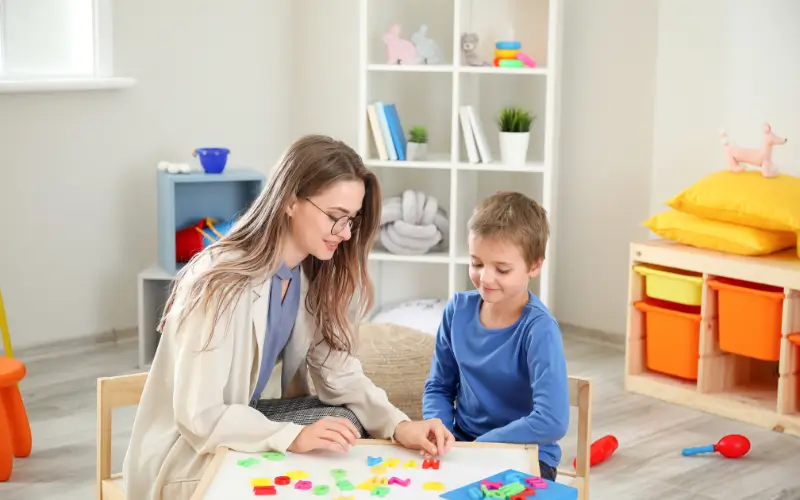
Speech therapy toys come in many different forms, each designed to support specific kinds of interaction, learning, or engagement. Some focus directly on language, while others create the conditions that support communication in a broader sense. Selecting from a variety of toy types allows therapists, teachers, and families to target different skills and adapt to each child’s needs and preferences.
Flashcards And Visual Aids
Flashcards and picture-based tools are often used to introduce new concepts and strengthen recall. These visual prompts make it easier for children to connect words with images, which helps with understanding and memory. Flashcards can support naming, identifying actions, categorising, and building simple sentence structures. Visual schedules and symbol cards are also useful for children who benefit from structured prompts or who are developing early communication skills.
Role-Play And Pretend Play Sets
Pretend play toys offer a flexible and rich setting for language use. Puppets, toy animals, figurines, and themed sets like kitchens or doctor kits allow children to explore different roles and scenarios. These kinds of toys help children practise conversational language in a way that feels playful and personal. They also support the development of longer speech patterns, such as giving instructions, describing actions, or responding in full sentences.
Interactive Board Games And Card Games
Games that include turns, rules, and structured exchanges provide a natural way to work on conversational timing and cooperation. Many speech-focused games also encourage descriptive language, reasoning, and listening. Some may involve guessing based on clues, matching items based on attributes, or explaining why an answer is correct. These types of toys are useful for group settings and can support both verbal and non-verbal communication.
Sound And Phoneme Toys
Toys in this group help children tune in to how words are built from sounds. Sound puzzles, electronic toys that pronounce words or letters, and games that highlight rhyming or syllables can be used to develop phonemic awareness. These tools are especially useful for children working on articulation or early literacy. They also encourage listening closely and practising sound sequences that may be difficult to produce.
Cause-And-Effect Toys
Cause-and-effect toys are especially helpful for children at the beginning stages of communication. These include toys that make noise, light up, or move when touched, pushed, or activated. This kind of interaction reinforces the idea that communication can lead to a response. For children with limited speech or those who are non-verbal, these toys provide a way to build attention, turn-taking, and intentional interaction.
Books And Storytelling Tools
Story-based tools give children a framework for developing expressive and receptive language. Interactive books with flaps or textures can prompt pointing, naming, or answering questions. Sequencing cards and story-building tools invite children to describe events, predict outcomes, or retell what happened in their own words. These activities support comprehension and help children structure more detailed speech.
Fine Motor And Multi-Sensory Toys
While not directly language-based, toys that engage the senses and hands can be a valuable part of speech sessions. Activities like building with blocks, tracing letters, or exploring textures help with attention, regulation, and motor planning. These aspects are often linked with communication readiness. Multi-sensory toys also create opportunities to talk about actions, describe objects, or respond to prompts during play.
How To Choose The Right Speech Therapy Toy
Some toys work well in one setting but not in another. Others might be popular but offer limited support for language goals. When selecting speech therapy toys, it’s important to think about how the child will interact with it, how the toy fits into the learning environment, and what kind of language use it encourages during play.
Skill Focus
The first step in selecting a toy is knowing which area of communication the child is working on. A toy should support the intended goal clearly and consistently. For example, a child practising sentence structure may benefit from a toy that encourages storytelling or sequencing, while a child who struggles with naming objects might need a toy that involves sorting or categorising. The toy should naturally lead to the kind of language the child is expected to use.
Age And Development
Children respond best to toys that match their current stage of development. A toy that is too advanced may cause frustration, while one that feels too simple might not keep their interest. It’s also important to consider attention span, fine motor skills, and play style. Some children benefit from toys with clear rules and structure, while others prefer open-ended activities with room for exploration. The right choice depends on where the child is, not just how old they are.
Engagement And Motivation
A toy should feel inviting and spark curiosity. Children are more likely to participate when the toy captures their attention and gives them a reason to interact. Bright colours, moving parts, or sound effects may appeal to some children, while others are drawn to pretend play or problem-solving tasks. When a child is interested in the activity, they are more willing to communicate, stay focused, and repeat skills that need practice.
How To Use Speech Therapy Toys In Sessions
Toys in a speech therapy setting are not just there for entertainment. The way they are introduced, used, and responded to plays a direct role in how children engage and communicate. The structure of the session, the child’s individual responses, and the adult’s role during play all shape how effective the activity will be.
Set A Clear Intention For Each Activity
Before introducing a toy, the therapist should decide what skill the activity is meant to support. A session might focus on describing objects, building sentences, or listening to instructions. Selecting a toy that naturally encourages that type of language helps create a more focused and productive interaction. Even open-ended toys can be used with a specific goal in mind, depending on how the session is framed.
Tailor The Interaction Style To The Child
Children respond differently depending on how much structure or guidance they are given. Some may need step-by-step instructions or visual prompts to stay engaged, while others prefer to lead the play with minimal interruption. The therapist can adjust their approach by observing how the child interacts with the toy and responding in ways that maintain focus without taking over.
Guide Conversation Without Taking Over
A child’s language often develops best when the therapist joins the play rather than directing it. By commenting on actions, repeating words, and modelling longer sentences, the therapist can offer language input in a natural and responsive way. For example, if a child says “dog,” the therapist might respond with “Yes, the dog is jumping.” This keeps the child in control while still introducing new language.
Involve Adults In The Child’s Daily Routine
When caregivers continue similar play-based activities outside of therapy, children have more opportunities to practise communication in everyday situations. Therapists can support this by demonstrating simple routines, sharing examples, or suggesting ways to use the same toy at home or in class. Repeating familiar activities across settings helps reinforce what the child is learning.
Observe Language Use Within The Play Itself
Play offers a practical way to track progress without relying on formal assessments. Therapists can observe how often the child initiates communication, how clearly they speak, and how they respond to prompts during activities. These observations give insight into what is improving and what may still need support. Small changes over time often indicate meaningful development.
Explore Speech And Language Tools From Educanda
Educanda provides a wide selection of speech and language resources developed to support communication skills across a range of learning environments. From flashcards and visual aids to games and interactive toys, our materials are chosen to help therapists, teachers, and caregivers work more effectively with children at every stage of language development. Browse our collection to find practical, engaging tools that align with your goals and fit seamlessly into your sessions or classroom activities.
Frequently Asked Questions
What age range do speech therapy toys typically support?
Most speech therapy toys are designed for children aged 2 to 10, though some resources can be used earlier or later depending on the child’s developmental stage. Early years tools focus on sound awareness, first words, and simple instructions, while resources for older children may involve more complex sentence-building, storytelling, or social interaction tasks.
Can I use speech therapy toys at home without a speech therapist?
Yes. Many toys are designed for use by parents or caregivers outside of formal therapy. Simple activities like matching cards, naming objects, or acting out scenarios with role-play sets can be done at home to support language development. If a child is working with a therapist, it’s helpful to ask for specific suggestions to use between sessions.
How do I choose a toy that matches a specific speech or language goal?
Start by identifying the skill the child is working on. For example, if the focus is on articulation, look for toys that include sound repetition, like flashcards with target words or games with sound-based prompts. For vocabulary, toys that involve categorising, naming, or describing are helpful. Product descriptions often include guidance on the skills supported.
Are these toys suitable for use in South African classrooms?
Yes. Many of the toys stocked by Educanda are designed for group use, small-group work, or one-on-one support in classrooms and therapy spaces. They are used by teachers, therapists, and learning support professionals across early childhood development centres, foundation phase classrooms, and special needs units.
Do any of your language development toys align with the CAPS curriculum?
Several of the resources offered through Educanda are suitable for use alongside CAPS learning outcomes, especially those focused on vocabulary development, listening, and verbal expression. While speech therapy toys are not always labelled by curriculum level, many are adaptable to CAPS themes and classroom routines.
What types of toys are helpful for non-verbal or minimally verbal children?
Toys that use strong visual cues, cause-and-effect responses, or sensory feedback are often useful. For example, toys that light up or play sounds when activated help build intentional communication. Visual aids like picture cards or symbol boards can support expressive language, even if spoken words are limited.
How often should speech therapy toys be used during home practice?
Short, frequent sessions are often most effective. Using a toy for 10 to 15 minutes a few times a week is a good starting point. The focus should be on creating regular opportunities for meaningful interaction rather than long periods of unstructured play. Consistency tends to support better outcomes over time.
Can the same toy be used to target different communication skills?
Yes. A single toy can often support multiple goals depending on how it is used. For example, a pretend play set might be used to encourage naming objects one day, and storytelling or role-play on another. The key is to adjust the prompts and structure based on the goal of the session.
Are there speech therapy toys designed for children with special needs or developmental delays?
Many toys on our website are appropriate for children with a wide range of learning and developmental profiles. Look for resources that offer visual structure, tactile feedback, or simplified interaction steps. Speech therapists and support teachers often adapt these materials for use with children who have autism, Down syndrome, or developmental delays.
What should I do if the child loses interest in a toy during a session?
If attention drops, try changing how the toy is presented. Break the task into smaller steps, introduce a new challenge, or allow the child to take the lead in choosing how to use it. In some cases, rotating toys or pairing them with a familiar routine helps bring focus back. It’s also helpful to observe whether the toy is too difficult, too easy, or simply no longer engaging for that particular goal.
Do I need training to use these resources effectively at home or in class?
Formal training is not required for most toys, but having clear guidance can make them more effective. Many resources come with suggested activities or examples of how to use them. Educators and therapists often find that with a bit of modelling and repetition, the strategies become easy to apply in everyday routines.
How should I clean and store speech therapy toys in a school or therapy centre?
Toys should be cleaned regularly, especially those used by multiple children. Plastic and non-electronic items can usually be wiped with mild soap and water or a disinfectant wipe. Fabric-based toys may need surface cleaning or occasional washing, depending on the material. Storing toys in labelled containers or baskets helps keep them organised and easy to access during sessions.